
Kandinsky was not a good musician. He played the cello and the piano as a child, and he kept notebooks about music his whole life, but he never performed anything. He listened. He went to concerts in Munich in 1910 and 1911, heard Schoenberg's music for the first time, and wrote the composer a letter that turned into a friendship. What he wanted from music was not the notes. He wanted a way of arranging colour and line so that the painting carried feeling the way a chord carries feeling, without describing anything.
Improvisation 28 is one of the few surviving attempts. It hangs at the Guggenheim in New York, oil on canvas, 44 5/16 x 64 inches (112.6 x 162.5 cm), painted in 1912. Kandinsky made thirty-five improvisations. Most were lost, destroyed, or painted over. What is on view today is the second version of number twenty-eight. The first version does not exist anymore. Nobody knows what it looked like.
What Kandinsky Meant by Improvisation
He took the word from music and used it loosely. In Concerning the Spiritual in Art (1911) and later in Reminiscences (1913), he sorted his paintings into three groups. Impressions came from nature, sketches of something he had seen. Compositions were built slowly with studies and revisions, the way a symphony is built. Improvisations sat in the middle. Unplanned, but not raw. Driven by an inner state rather than by a subject, and often painted in a single sitting.
By 1912, he had already stopped painting recognisable subjects. The riders on horseback and the blue mountains of his earlier work were gone. What replaced them was a vocabulary of colour and line that he believed could carry emotion more directly than any image of a person or place. Whether that belief was correct is a separate question. The improvisations were his test of it.
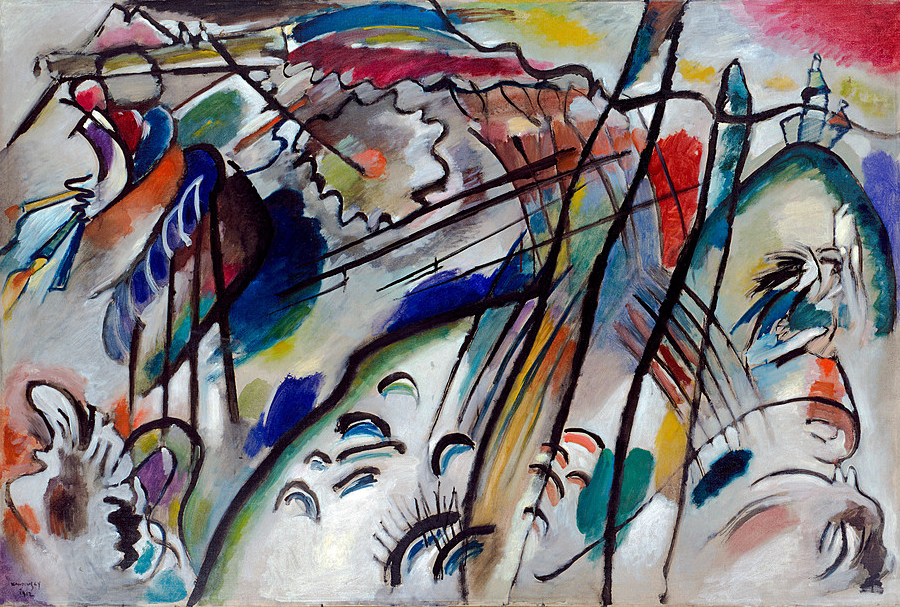 Improvisation 28 (Second Version), 1912. Oil on canvas, 111.4 by 162.1 centimetres. Solomon R. Guggenheim Museum, New York.
What the Canvas Actually Shows
Start with the left half. There is a broad shape in red and blue that could be a boat, or a wave, or a hill, and it never settles into one. Above it a curve of yellow arcs up and to the right. On the right side of the canvas three or four black lines radiate from a single point, like a fan, or a collapsed mountain range. In the lower centre there is a cluster of small dark marks that could be figures, stones, or notes on a stave. Kandinsky would not have answered the question. He wanted all three readings available at once.
The black line is the spine. It is drawn in oil with a loaded brush, and it thins and thickens along the length of the stroke. In some passages it is almost liquid, trailing off into the surface. In others it is dry and jagged, catching the weave of the canvas underneath. Kandinsky worked it the way a calligrapher works a character. One continuous movement. No erasure.
Colour sits underneath and around the line in wide, semi-transparent fields. Red on the left. Blue and pale green in the centre. Yellow on the upper right. He applied the paint thin, sometimes with a brush and sometimes with a palette knife, and left the ground visible in a few places between the fields. In reproduction the canvas often looks heavier than it does in the room, where the white ground comes through and pushes the colours forward.
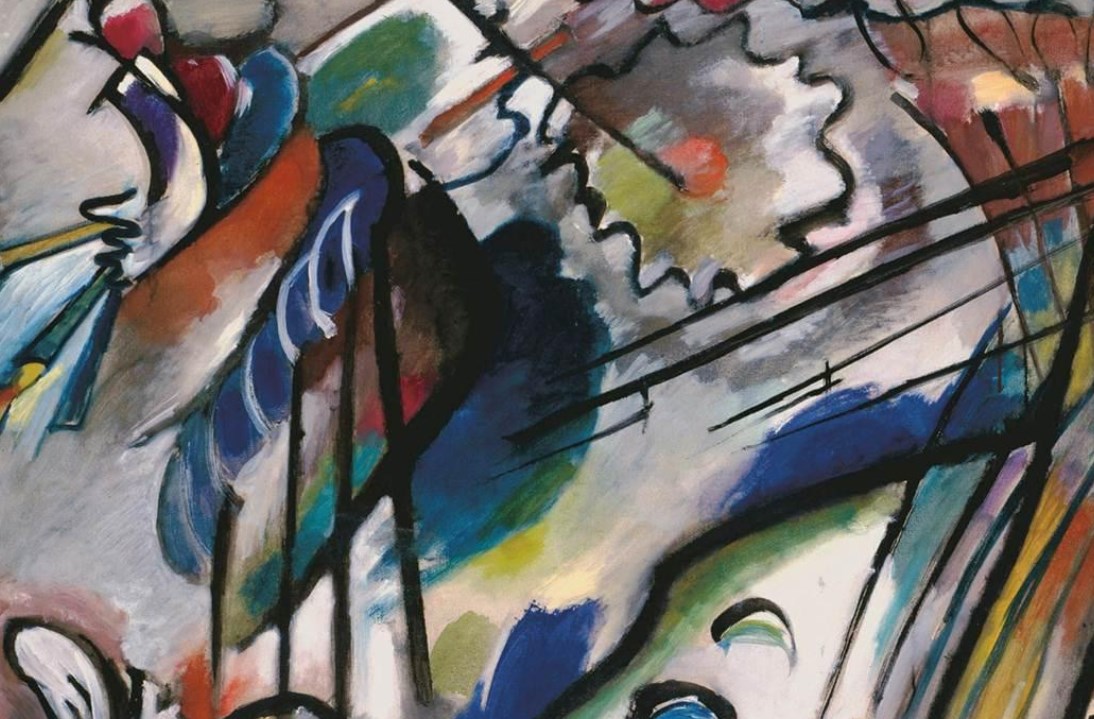 The black line was drawn in oil with a loaded brush. It thins, thickens, and breaks across the surface. In some passages the canvas weave shows through.
Synesthesia and What It Really Was
Kandinsky described colours as sounds and sounds as colours, and this gets repeated so often that it has become the standard explanation for his paintings. The truth is messier. He was interested in Theosophy, he read Rudolf Steiner, he believed colour carried a vibration that could act on the viewer directly. Whether he had clinical synesthesia is still argued by neurologists who have read his letters. What matters for the paintings is simpler. He assigned specific colours to specific instruments in his notebooks, and he used those assignments as a working system, not as a private experience.
Yellow was a trumpet. Blue was a cello. Red was a drum. These were not metaphors he invented on the spot. They were part of a theory he had spent years building, and every canvas from this period tests it. When the yellow arc rises above the red field in Improvisation 28, that is a phrase in the score. Not a picture of music. A painting that behaves like one.
Why a Print Cannot Hold the Line
The argument of the painting sits in the weight of the black line. It is not a flat contour. It is a loaded brush dragged across a textured surface, and the amount of paint in each part of the stroke changes the way the line reads. A digital print lays pigment in an even layer across the image, and the line flattens. The dry passages lose their drag. The wet passages lose their shine. The breaks between strokes become black dots on a coloured background instead of pauses in a phrase.
A hand-painted oil reproduction is built in the order Kandinsky worked. The broad colour fields first, in thin washes, allowed to dry. Then the black line, drawn in one movement with a brush loaded the way a calligrapher loads a brush. Then the smaller marks and accents, set on last. The result keeps the physical weight of the line, which is the only thing that makes the painting sing.
What to Look For
Start at the top of the black line and follow it down. Notice where the paint thins and where it thickens. Notice where it breaks and where it continues. Then look at the colour around it and try to see the yellow arc and the red field as two instruments playing at once. That is what Kandinsky was after. Not a picture of music. A painting that behaves like one.
Then comes the part that makes the improvisations a puzzle. Kandinsky numbered thirty-five of them. Only a handful survive in their second versions. The first version of number twenty-eight is gone. Nobody knows what it looked like, or whether Kandinsky destroyed it himself or painted over it. Most of the others are scattered across museums and private collections, some on permanent display, some locked in storage, some sold at auction decades ago and never seen again in public.
Improvisation 28 itself exists in a single surviving version, and it rarely leaves the Guggenheim. It cannot be bought. It cannot be borrowed. The rest of the series, on the other hand, is a different story. Improvisation 31, the one Kandinsky called Sea Battle, is one of the few improvisations you can actually live with. So are Improvisation 7, Improvisation 19, and about a dozen others from the same years. Each one was built the way Kandinsky built them, with a loaded brush, in oil on canvas. The puzzle is figuring out which one belongs on your wall.
See the surviving improvisations as hand-painted oil reproductions at oilpaintings.com. Each canvas is built in the order Kandinsky worked, from the first colour field to the last stroke of the black line. Find the improvisation that belongs on your wall
Images: Wikimedia Commons (public domain).